In a recent paper (Entropy, vol. 27 p.1227 (2025)) a group of physicists, chiefly including Carlo Rovelli, argues that we have got the Second Law of thermodynamics wrong. They contend it is not a real law (and on this I could agree), but is instead a logically wrong, circular argument. And this point deserves a bit more of a reflection, since DS≥0 is one of the boldest claims ever formulated about reality, and is found identical in thousands of physics textbooks.
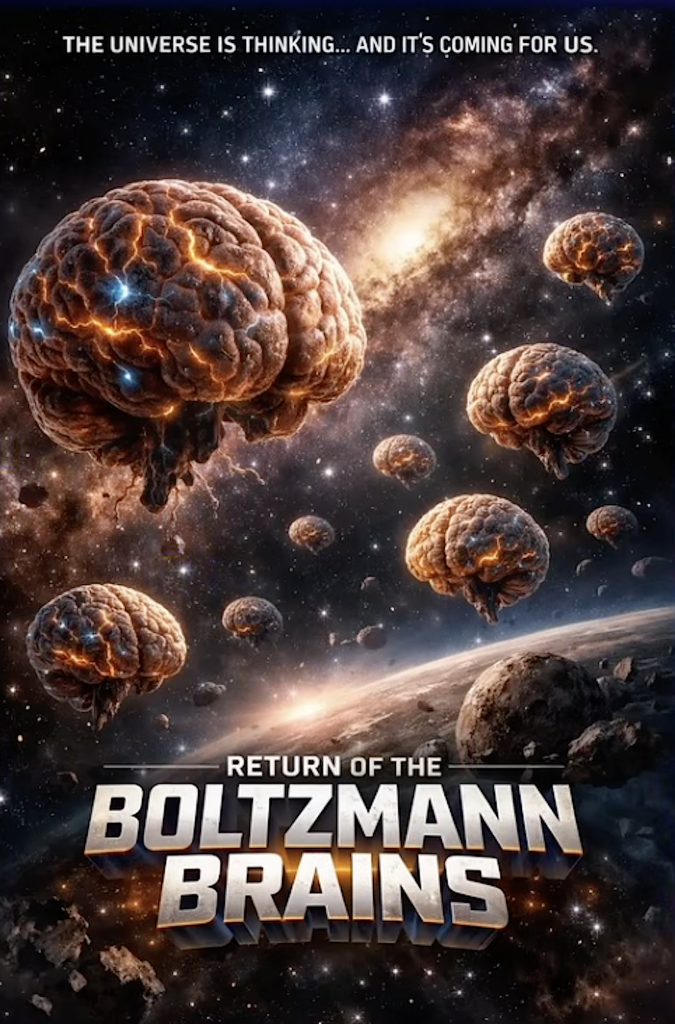
As time passes, entropy in the universe increases without ever reversing its path. Among other, more funny things (vases breaking, drops of ink mixing, children growing old, etc.), this means that all the particles in the universe become more and more mixed up. Life at that point (and it is not a superficial detail, see the “anthropic principle”) will be impossible. But this is not the end, like the epic song by the Doors claimed, because a state of high entropy is never perfectly smooth. Consider this mixture of particles of different kinds that remains in thermal equilibrium for an arbitrarily long span of time. If we believe statistical mechanics, there will be fluctuations at thermal equilibrium, and in principle all configurations can be reached by such fluctuations, given enough time available. Consider one of these random fluctuations giving rise to molecules, and right away to proteins, to neurotransmitters, and at that very moment, just by chance, precisely to a brain like yours. A big beautiful brain, complete with your memories, information and perception about this very moment, and all things in (what you believe to be) your past life, but with no corresponding external physical world. Such a brain arising as a fleeting fluctuation is called a “Boltzmann brain”. Such a hypothetical brain would have exactly our current memories, perceptions, and it would know and feel precisely what we know and feel right now.
Around the 1890s, Boltzmann was grappling with the Second Law, and the apparently low entropy of the observed universe. His idea more or less was that the universe is (or could be) in global thermal equilibrium; then, rare fluctuations away from equilibrium can occur; and we observe a low-entropy world because only in such fluctuations could observers like us exist (the “anthropic” hypothesis for the origin of the universe, which he however avoided to commit to, and instead attributed to his assistant, dr. Schuetz, in L. Boltzmann, Nature vol.51, p.413 (1895)). He entertained the idea that our whole observable universe might be such a fluctuation. The key step is that smaller fluctuations are vastly more probable than larger ones. Therefore, it is far more likely to observe a fluctuation into a small object (albeit complicated) as a single self-aware system (a “brain” with false memories), than an entire universe also including 8 billion real human brains with as many memories and so on.
The actual term “Boltzmann brain” was not copyrighted by Boltzmann, but was coined only around 2004 in a series of papers about cosmological inflation after the Big Bang, by Andreas Albrecht and Lorenzo Sorbo, both at UC Davis at the time. The impossible conundrum, if you take the laws of nature seriously, is that the universe does not exist. Period. You, a flimsy Boltzmann brain, just believe it does, in the very moment you are reading these lines (another small fluctuation: you think I wrote them, but your brain is actually tricking you to believe that). Now, Rovelli and friends revisit this semi-old problem, and ask if it has something to do with specific assumptions that Boltzmann made, notably about the Second Law (that he could never strictly prove, and probably led him to drop the rope). Most importantly, Boltzmann envisioned that particles basically behave like a classical gas. But we know that the real (?) fundamental particles in the Standard Model are very different. Some of them, like quarks, never exist alone, they only appear in clumps, that your Boltzmann brain calls neutrons and protons. And clearly, gravity too does a lot of clumping, giving rise to planets and apples and Newtons looking at both. But in their new paper Rovelli and friends conclude : “At present there is no fully rigorous argument that relies only on established physics to dispel the possibility of the [Boltzmann Brain] hypothesis.” Because of this, they say, the Second Law of thermodynamics is not a law: it is a circular argument, and is logically wrong. Why does entropy increase? Because we assume that it was smaller in the past. And why do we do that? Because we have records of the past, but not of the future. But why do we trust the records? Well… because entropy increases.
We assume that entropy was small at the Big Bang. All reliable records of the past agree with the idea that the Big Bang had small entropy. You can go out and observe the cosmic microwave background, which is definite evidence that the universe was in a much lower-entropy state several billion years ago. But what if you are not seeing leftover photons from some Big Bang, but a peculiar radiation field entering your telescope right here in your nearby environment? In a fluctuating-universe scenario, it is possible to see such particular photons, but it is overwhelmingly likely that they randomly fluctuated into existence, without any connection to an earlier low-entropy state.
What if entropy had its smallest value, instead, 1000 years ago, and before that it was much bigger? Time ran in reverse, from some far-far-faraway moment until 1000 years ago, and then it switched forward up to now. In their paper, Rovelli and friends call this the “1000CE hypothesis”, logically just as plausible as the Big Bang hypothesis. Well, maybe the logic construction of the argument is formally correct, but the underlying problem is not new. In physics things I always remain a big fan of Rick Feynman, and trust him that we use certain equations in physics only because they describe our observations in the simplest (Ockham’s razor) way. The universe does not need our stupid equations. We put the smallest entropy at the beginning of the universe, rather than a 1000 years ago, because we should otherwise assume a lot of unnecessary complexity. Put it at instant t=0, and dynamics gives you the universe.
The Boltzmann Brain argument is also deeply intertwined with the Simulation Hypothesis, on which I wrote another Sunday letter some time ago. While they come from different fields (thermodynamics vs computer science), they share the same core skeptical conclusion: that our perceived reality is very likely an illusion. Hail Plato, Descartes and Zhuangzi. The standard Simulation Hypothesis (like Nick Bostrom’s, in Philosophical Quarterly vol. 53 (2003) pp.243–25) assumes a conscious “simulator” (for Bostrom, an advanced civilization of the remote future) who is running a giant code on a giant computer. A Boltzmann Brain is essentially a natural simulation. Instead of a computer, the “hardware” is a brain (yours…) that was formed by chance in a high-entropy universe, and the “software” is the stream of consciousness and false memories and false reality of this very moment, generated by that brain’s internal states. Both hypotheses suggest that your memories of the past (childhood, history books, yesterday’s breakfast) are “plugged in”. In a simulation, they are data files. For a Boltzmann Brain, they are specific neural configurations that happened to stabilize for a split second. Both are used as “reductio ad absurdum” arguments. If a theory (like certain models of the Multiverse, Susskind etc.) predicts that there should be many more simulated minds, or Boltzmann Brains, than real biological ones, then the theory is problematic, because it implies we are almost certainly not who we think we are. Both scenarios create a logical trap, sort of Hilbert’s paradox (he was a big Boltzmann brain before you). If you conclude that you are a Boltzmann Brain (or a simulation), then the very science and observations you used to reach that conclusion are likely fake, which undermines the argument itself. In short, a Boltzmann Brain is a simulation without a programmer.
It is possible that in my universe I am surrounded by millions of Boltzmann brains, but I am certainly not one of them. My memories are too inaccurate. A few days ago I lost my cell phone, and found it some hours later in the fridge.